Dip vs Gel vs Acrylic Nails: How to Choose
Compare dip, gel, and traditional acrylic nails by application, curing, removal, upkeep, and the practical skills each method requires before you choose.
Choose dip, gel, or traditional acrylic by the complete process you can use and maintain appropriately. Dip commonly uses powder with compatible resin liquids and activator, gel needs its specified light-curing method, and traditional acrylic combines liquid monomer and powder. None is automatically the healthiest choice for every person.
Look beyond the finished photograph. Application skill, skin-contact control, removal, upkeep, and your own nail condition matter as much as the desired color or length.
Understand what the category names leave out
Gel can mean several different products, including soak-off color and harder enhancement systems. Dip may use a traditional resin-and-activator method or a gel-based variation. Acrylic often means the liquid-and-powder method in ordinary manicure discussions.
The terms do not provide a full ingredient list. Related materials may appear across categories, and switching labels does not automatically remove an allergy concern.
Ask what exact system is being used, what hardens it, and how it is removed. Those three answers are more useful than a broad claim that a manicure is clean, natural, or chemical-free.
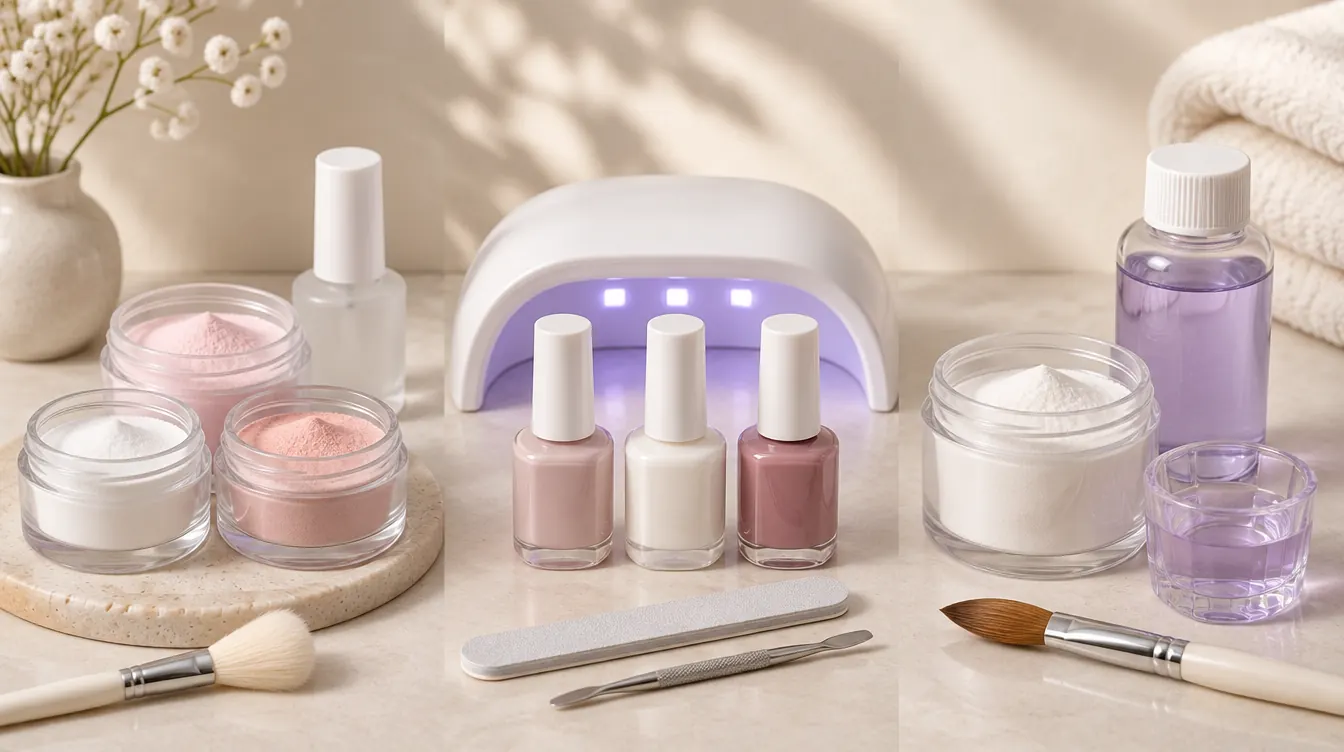
Compare the main workflow differences
| Feature | Traditional dip method | Light-cured gel system | Traditional acrylic method |
|---|---|---|---|
| Main application | Compatible resin layers and powder | Gel applied under its instructions | Liquid monomer and powder shaped together |
| Hardening | System-specific activation and finish | Specified compatible curing lamp and timing | System-specific chemical setting |
| Lamp normally part of the method? | Usually no, unless a gel variation is introduced | Yes for light-cured products | Usually not for the acrylic itself |
| Extensions required? | No | No | No, although commonly used for extensions |
| Removal | Often compatible acetone removal | Depends on soak-off versus file-off product | Depends on exact system and construction |
This table describes common methods rather than every hybrid service. Read the actual product directions before combining stages or selecting equipment.
Dip: powder layers need a coherent liquid system
Dip can appeal if you want a powder-based coating without a traditional acrylic bead-building method. A lamp-free resin system still needs careful activation, controlled layers, and appropriate finish.
Do not assume powder means no reactive liquids. Keep the application on the nail rather than skin, and avoid sharing powder that other people have dipped into.
The dip overview explains the stages in more detail. It is a useful starting point before deciding whether the personal setup and removal work fit your routine.
Gel: curing is part of the product system
Light-cured gel requires the specified compatible lamp and directions for layer thickness, time, and application. A shiny or hard-feeling surface does not prove that an improvised lamp choice or shortened curing cycle was appropriate.
Do not use a random lamp because its advertised wattage looks stronger. Compatibility is not established by a single number, and an unrelated lamp can create uncertainty about the finished coating.
Gel lamps involve ultraviolet exposure, including devices described as LED. Follow appropriate hand-protection guidance and the complete product method if choosing this category, rather than interpreting LED as no UV.
Acrylic: shaping and timing are distinct skills
Traditional acrylic involves combining liquid monomer and powder and shaping the material during its working stage. That differs from attaching powder through dip layers.
The method needs control over product ratio, placement, skin margins, structure, and setting. A broad beginner manicure guide cannot replace the training needed to build and refine an unfamiliar enhancement confidently.
Do not substitute household adhesive or unrelated liquids to make the process easier. If long extensions or structural work are your goal, professional help may be more practical than treating the supplies as a simple paint kit.
Decide what length and structure you actually need
A short overlay and a long extension create different everyday handling questions. You may want color on natural nails without additional length, regardless of which system appeals visually.
Longer nails can be inconvenient for typing, contact lenses, gloves, or other tasks you perform. Think about those tasks before choosing a photograph’s length as the default.
Do not assume thicker always means stronger or better.
Compare removal before comparing convenience
Find out whether the exact coating soaks off, requires trained filing, or uses another directed approach. Do not assume one acetone routine applies to every product sold as gel or acrylic.
Never peel or pry off a hard coating because it has started lifting. A shorter-looking removal shortcut can create a much larger nail-care problem than allowing time for the proper method.
The dip removal guide focuses on that category. If the product on your nails is unknown, get suitable professional guidance rather than experimenting with stronger solvents or aggressive filing.
Include maintenance in the decision
Think about the appointments or home work needed when the coating grows out, chips, or lifts. A durable finish is not an instruction to ignore changing condition until a promised number of weeks has passed.
Look at bare nails between manicures rather than immediately hiding every change under another coating. Do not cover painful, discolored, or separating nails as a cosmetic repair.
The dip lifespan guide explains why condition matters more than maximizing a countdown. The same practical principle applies when considering other durable enhancements.
Compare the service as well as the material
When considering professional application, ask what exact coating is included, whether length is added, and how future removal or maintenance will be handled. Those details can differ even when two services share the same category name.
Before booking or buying, check these practical points:
- What product system and hardening method will be used?
- Does the planned length fit your ordinary tasks?
- Who will handle lifting or an unexpected problem?
- What is the appropriate removal process for every layer?
Keep the answers with your own notes. Knowing the actual coating is particularly useful if another professional later needs to remove it. A familiar category label is less informative than that complete record.
Keep safety questions specific
Read labels, provide suitable ventilation, avoid skin contact with reactive products, and keep flammables away from heat and ignition sources. Use equipment and protective measures appropriate to the actual method.
Stop for pain, swelling, rash, or respiratory symptoms and seek appropriate care. Persistent nail or skin changes deserve a dermatologist’s advice rather than a category switch based on marketing language.
Choose the method whose complete process you understand and can maintain. It is reasonable to choose ordinary polish or no coating when the removal, equipment, or handling demands do not fit your current routine.
Frequently asked questions
Is dip completely different from acrylic chemistry?
Not in every sense. Dip powders and traditional acrylic systems can involve related polymer materials, while their application liquids and methods differ. Compare the actual product system rather than treating category names as complete ingredient lists.
Is LED gel a lamp-free manicure?
No. LED describes the curing light source, not absence of a lamp. Use the product’s specified compatible lamp and curing directions rather than assuming any light or air drying is enough.
Can all gel nails be soaked off with acetone?
No. Soak-off gel and harder file-off systems have different removal needs. Identify the exact product and obtain appropriate help when the coating or removal method is uncertain.
Does a previous reaction mean another category will be fine?
Do not assume that. Nail systems can involve different or overlapping sensitizing ingredients. A prior reaction deserves dermatologist guidance rather than a trial based only on a sensitive or free-from label.