Clean and Vegan Mascara: Ingredients Guide
Read clean and vegan mascara labels with confidence: understand ingredient roles, animal-derived ingredients, certification, and basic eye safety.
Choose clean or vegan mascara by checking what the claim actually covers, then read the current ingredient list and use directions. Clean is not a universal recipe, and vegan is not a guarantee that a product will suit your eyes. Your priorities may include animal ingredients, testing policies, wear, removal, or a known sensitivity; evaluate those separately.
A long chemical name is not a useful danger score. Mascara needs ingredients that supply color, build texture, hold a coating on lashes, and keep the product usable. Understanding those jobs helps you make a more practical choice than comparing marketing words on the front of the tube.
Keep the label claims separate
| Claim | What it can tell you | What it does not establish by itself |
|---|---|---|
| Clean | Compliance with a stated brand or retailer policy | One universal formula or guaranteed eye tolerance |
| Vegan | A claim about animal-derived ingredients, with scope to verify | That the formula contains only plants |
| Cruelty-free | A claim about animal testing, with scope to verify | That every ingredient is free of animal origin |
| Hypoallergenic | A manufacturer’s marketing claim | A guarantee against an allergic reaction |
| Natural or organic | Information about sourcing or a defined certification | That the finished mascara is automatically safer |
In the United States, FDA has no federal standard or definition governing the cosmetic term hypoallergenic. That makes your actual ingredient concerns more useful than assuming the word settles the question. A retailer’s clean standard also needs to be read on its own terms rather than treated as an official safety approval.
Understand the formula’s main jobs
Pigments provide the visible color. Waxes and other structuring ingredients help create the body of the product and influence how much it deposits. Film-forming ingredients help leave a coating on the lashes. Liquids, emulsifiers, and related ingredients help bring the components into a usable formula.
Preservatives help protect a formula from microbial growth. Their presence is not evidence that a product is dirty or low quality. A preservative-free claim is not a reason to assume a tube is safer, especially when a wand repeatedly returns from your lashes to the container.
The ingredient list does not tell you exactly how a mascara will separate, flake, or remove. Ingredients work together, and their names alone do not reveal every concentration or manufacturing detail. Use the directions and intended finish alongside the list.
For application problems, how to apply mascara without clumps addresses loading and technique. Switching to a vegan or clean label does not automatically correct an overloaded wand or repeated brushing through a drying coat.
Recognize animal-derived ingredients without overgeneralizing
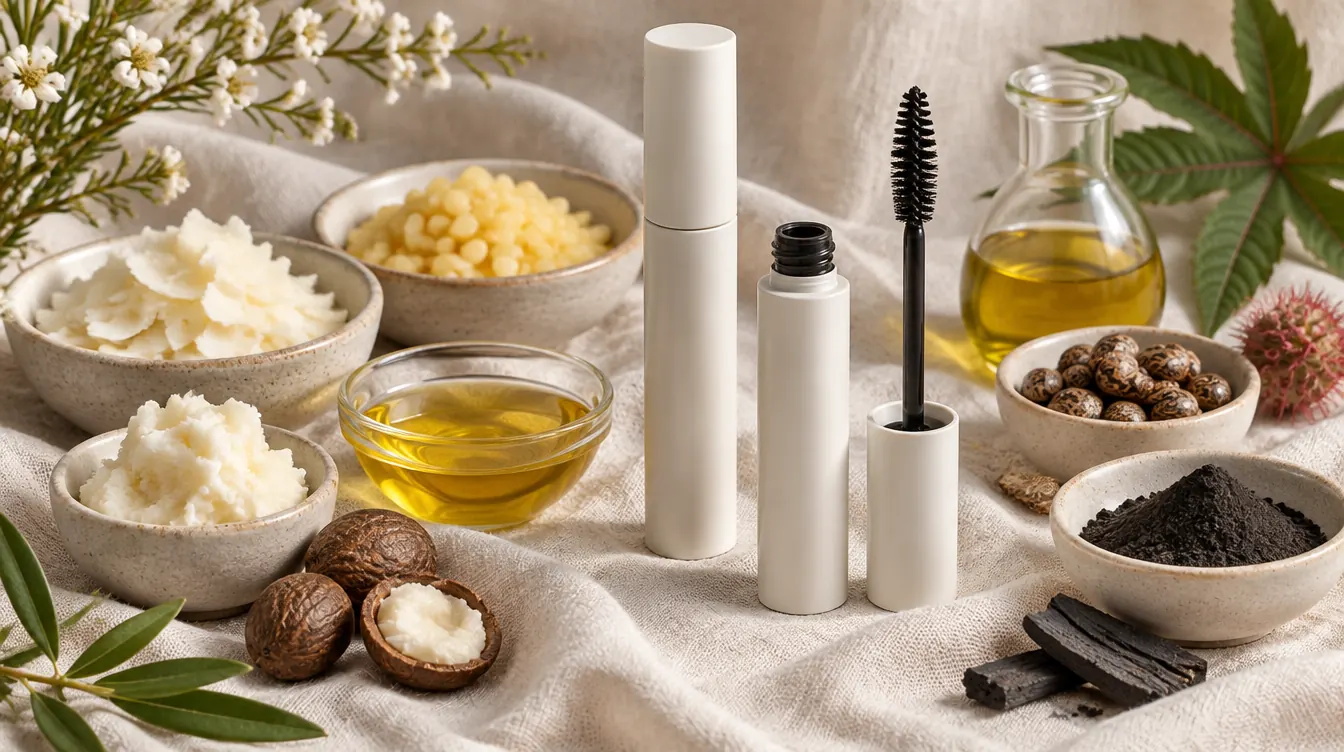
Beeswax may appear as beeswax or Cera Alba. It is an animal-derived ingredient, so it does not fit an animal-ingredient-free vegan formula. Shellac is an insect-derived material that may be used as a film former. Carmine is an insect-derived red colorant, relevant when checking colored makeup formulas.
These examples help you spot clear questions; they are not a complete screening system. Some ingredient names do not make their original source obvious. If a source can vary, a manufacturer’s product-specific confirmation or a relevant certification is more useful than guessing from the name.
Do not assume that every mascara in a brand’s range shares the same status. A vegan claim may cover one formula or selected shades. Waterproof, washable, tubing, and colored versions can have different ingredient lists even when their packaging looks similar.
Check certification and testing claims
A recognizable certification can reduce the amount of ingredient-source research you need to do, but first confirm what its standard includes. The Vegan Society’s Vegan Trademark, for example, addresses animal-derived ingredients and defined animal-testing criteria. It is not simply a promise that a product contains botanical ingredients.
Check whether the exact product is covered, rather than relying on a general statement about the brand. Certification marks should correspond to a real standard and a verifiable product or manufacturer record. A leaf graphic or an unqualified green package does not establish certification.
Animal ingredient origin and animal testing are related ethical questions, but they are not interchangeable. A product could avoid a particular animal ingredient without giving you enough information about testing. Read the policy that matters to your own purchase criteria.
Read a mascara label in six steps
- Identify the exact version. Note the formula name, shade, and whether it is washable, waterproof, or tubing. Avoid borrowing an ingredient list from a different version.
- Read the full current list. Start with the package you will use and compare the manufacturer’s information if needed. Old retailer images may show an earlier formula.
- Check known personal exclusions. Look for an ingredient you have been advised to avoid, rather than relying only on broad clean or sensitive-eye language.
- Verify the vegan or testing claim. Find the scope of the claim and any certification. Ask the manufacturer if the exact product status or ingredient source remains unclear.
- Read wear and removal directions. Make sure the product fits the routine and remover you can use comfortably. Do not choose solely from the front-label slogan.
- Keep the identifying details. Retain the package or a clear record of the formula and batch information so you can identify it if a question arises later.
If you add a separate primer, repeat the process for that product. A vegan mascara does not make the undercoat vegan, and a shared brand name does not establish compatibility. See whether lash primer is worth it before adding another formula to the routine.
Put eye comfort ahead of a slogan
Natural origin does not guarantee safety or freedom from irritation. Botanical extracts and fragrance ingredients can still be unsuitable for an individual. Likewise, a synthetic ingredient is not automatically unsuitable because its name sounds unfamiliar.
Follow any product-specific trial instructions, but do not put mascara on an eyelid as an improvised patch test. A dermatologist can help investigate recurring skin reactions; persistent eye irritation needs appropriate medical advice.
Use only cosmetics intended for the eye area, keep the wand clean, and never share the tube. Do not dilute mascara with water, saliva, oil, or another product. Stop using a formula that causes irritation instead of continuing because its marketing sounds reassuring.
Choose the claim you can verify, keep the directions available, and judge the finished mascara by its intended use, condition, and how it fits your own needs.
Frequently asked questions
Does vegan mascara mean cruelty-free?
Do not assume the claims cover identical issues. Vegan ingredient claims concern animal-derived materials, while cruelty-free claims concern animal testing. Some vegan certifications address both, so check the actual standard and whether the specific product is covered.
Is clean mascara safer for sensitive eyes?
The word clean alone cannot establish that. Review the ingredient list for substances you know you react to and follow the directions. Stop if irritation develops and seek medical advice if it persists.
Can a vegan mascara contain synthetic ingredients?
Yes. Vegan does not mean every ingredient comes from a plant. Synthetic ingredients can fit a vegan formulation; animal origin and testing requirements are separate from whether an ingredient is manufactured or naturally sourced.
Can I judge a mascara from one ingredient?
Usually you need more context, including the complete formula, intended use, and your own known sensitivities. An ingredient name does not reveal the whole product performance or concentration. Contact the manufacturer when a source or label detail is unclear.